
AI agents
Buyers ask AI first. Make sure your client is the answer.
A client's AI agent is the client's public, structured profile that Claude, ChatGPT and other AI assistants read, plus the research that works for the client: their market, competitors and vendors. You build it in the client's workspace and run its visibility check whenever you want, to see whether AI assistants recommend the client and who wins instead.
The profile is free, no credit card. Visibility checks and client-ready reports are on the Practice plan.
Already have the workspace? Add the agent from the sidebar →
From workspace to visibility report in four steps.
Nothing for the client or their buyers to install.
Build the workspace
One URL. Haycion builds the client's profile, ICPs, competitors and positioning. You check it and correct what's wrong.
Set the guardrails
What the agent can say, what it can share, where it can represent the client. The client signs off.
The agent goes to work
It publishes a picture of the client that AI assistants can read. Whenever you run it, it asks the questions buyers ask and tracks whether the client is cited. Where it isn't, it hands you ready-to-install fixes.
Send the report
Each time you run it: how AI describes the client, how often they were cited, a competitor visibility comparison showing who won instead, and what you changed. Under your name.
GuardrailsWhat the agent says is what you approved.
A client's reputation shouldn't go to a black box. The agent works inside limits you and the client set, and shows you its work.
You set the guardrails.
The agent represents the client accurately, within limits you decide.
- What it can say about products, pricing, and positioning
- What it can share and what stays inside the workspace
- Where it can represent them, and where it stays quiet
It keeps you in the loop.
It watches how AI assistants treat the client and tells you what to act on.
- How AI is describing the client, in its own words
- How often they're evaluated, as a vendor and as a competitor
- Where competitors are winning, and what to change
Nothing is published until you choose to publish it.
Build the client's workspaceSetting up the agent is fast. Earning AI's trust is the job.
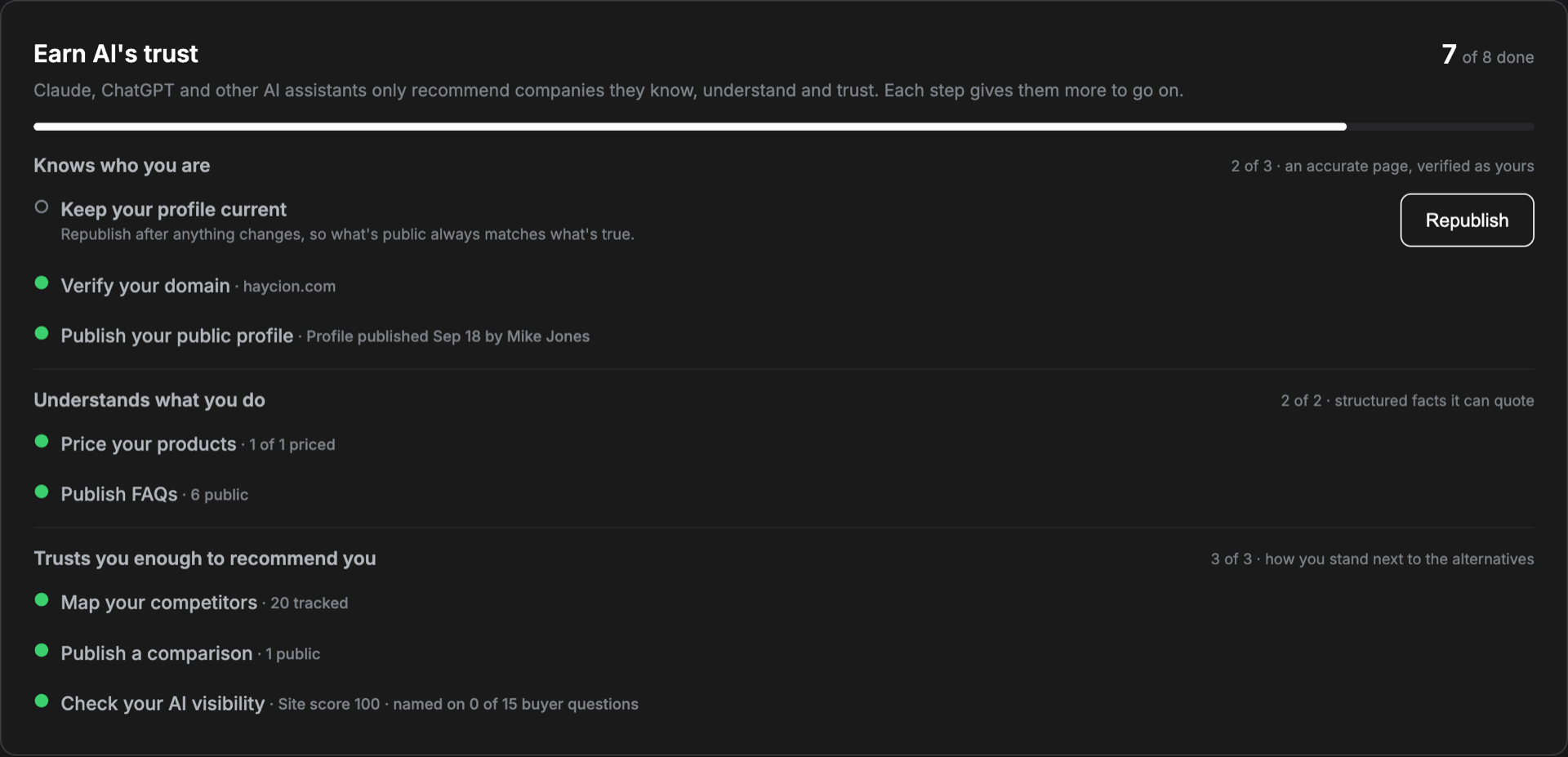
AI assistants only recommend companies they know, understand and trust. You work through the checklist for the client, and keep it current as they change.
The deliverable that turns a project into a retainer.
One page, whenever you run it. The questions buyers asked, whether the client was recommended, who won instead, and what you changed.
Send it as a PDF under your name, or give the client access to the workspace and let them watch the number move.
Why clients renew.
A retainer survives when the client can see what they're paying for. The agent gives you something to show, and the workspace behind it gives you something to say.
- Business they can see. AI citations counted, run over run, in the assistants their buyers use.
- A report under your name. The client hears it from you, with the reasoning behind every change.
- Nothing they could do themselves. The agent is grounded in the workspace you curate, not a form they fill in.
You keep the relationship. The agent keeps the client visible. Why this matters to your client →
Questions consultants ask
What is a client's AI agent?
A client's AI agent is the client's public, structured profile that Claude, ChatGPT and other AI assistants read, plus the research that works for the client: their market, competitors and vendors. You build it in the client's workspace and run its visibility check whenever you want, to see whether AI assistants recommend the client and who wins instead.
Where does it show up?
Inside Claude, ChatGPT and other AI assistants the client's buyers already use. There's nothing for the client or their buyers to install.
Who controls what it says?
You and the client. Guardrails are set up front, the client signs off, and the agent says only what was approved. Nothing is published until you publish it.
Can the client see the report?
That's your call. Send it as a PDF under your name, or give the client access to their workspace so they can follow the numbers themselves.
What does the agent measure?
An AI visibility audit of 16 discoverability signals scored 0 to 100, AI citation tracking in ChatGPT, Claude and Google AI Overviews using the questions buyers ask, a competitor visibility comparison showing who is cited instead, and a list of ready-to-install fixes for what is missing.
Does every client need their own agent?
One workspace, one client, one AI agent. Each is isolated, so nothing one client's AI agent learns reaches another.
Know first. Be found first.
Build the client's workspace, set up their AI agent, and send the first report once it's run.